28 November - 05 December
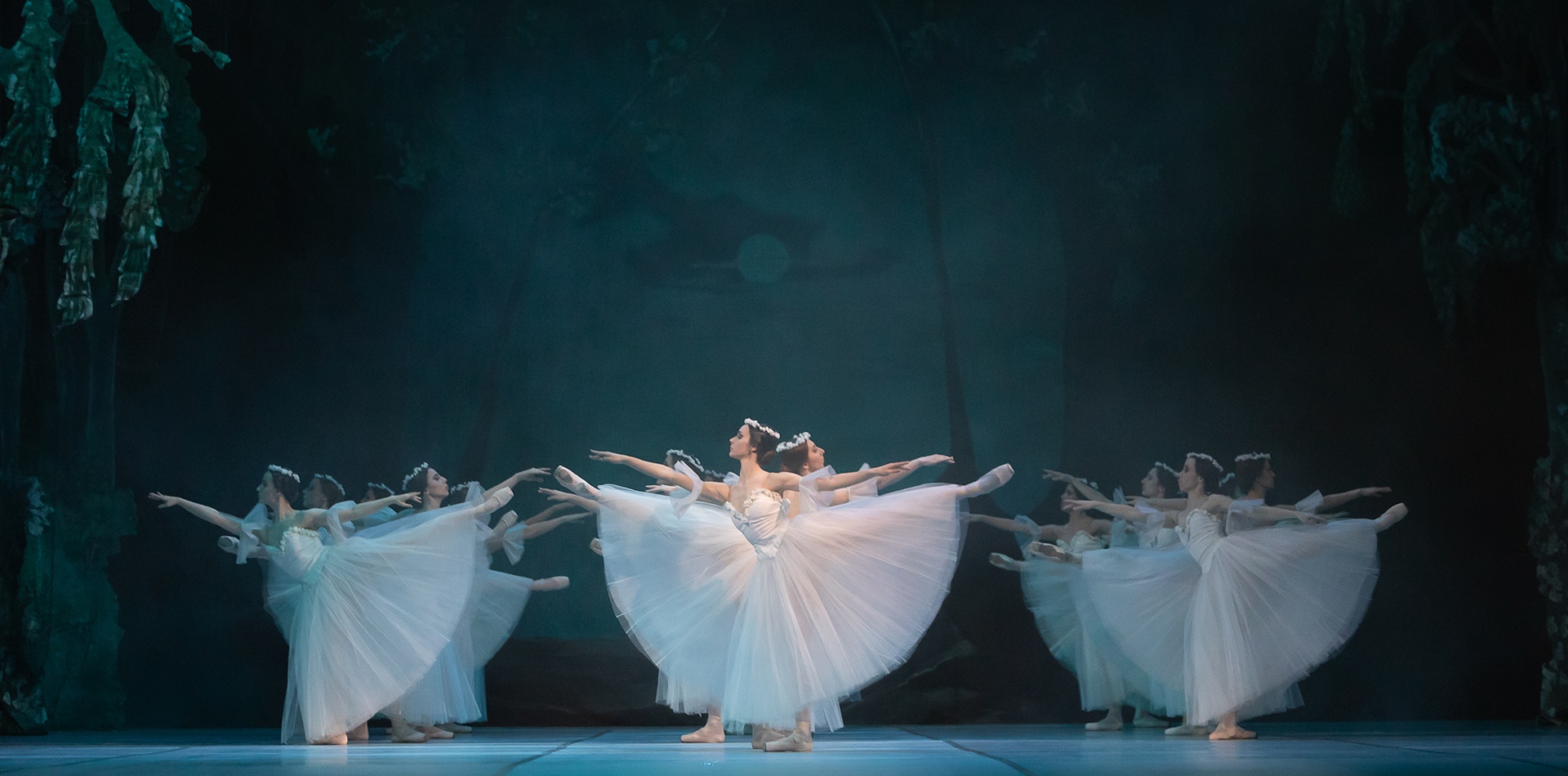
GISELLE
Ballet by Adolphe Adam
-
Saturday 28 Nov 2026 19:00
-
Saturday 05 Dec 2026 19:00
Preview
The performance on November 28, 2026, is dedicated to the 95th anniversary of the birth of Prof. Petar Lukanov
************************
Children under 6 are not admitted to adult performances!
*************************
“Giselle” is a poetic, musical and choreographic jewel", Pyotr Ilyich Tchaikovsky
The story of the tragic love of the lovely maiden Giselle and Prince Albert captivates even today, a love that even the vengeful ghosts and their queen Myrtha cannot defeat.
Beautiful music, a vivid sense of theatricality and interpretive skill make the performance unforgettable, joining the greatest achievements of the great art of ballet.
“Giselle” is probably the most prominent example of a romantic ballet and has the oldest choreographic concept bringing together different sources of inspiration: Spain, Germany, Italy and France.
The story of the ghost maidens who punish men by making them dance to exhaustion appears in Victor Hugo's 1829 poem about a young Spanish woman who dances to exhaustion. In Heinrich Heine's 1835 collection called “From Germany”, there is a reference to Wilis – the transparent dead maidens, half-nymphs, half-vampires who pursue their betrothed. Heine inspired Théophile Gautier, who suggested the text to Jules-Henri Vernoy de Saint-Georges to write the libretto. The text was ready in three days and sent to the director of the Paris Opera, Léon Pillet. In turn, he sought a production in which to present Carlotta Grisi to the Parisians. Both liked the proposed story and so the work began. Inspired, Adolphe Adam created the music in about two months.
The work in two acts with music by Adolphe Adam and libretto by Jules-Henri Vernoy de Saint-Georges and Théophile Gautier was first performed on 28 June 1841 in Paris, choreographed by Jean Coralli and Jules Perrot. Perrot set the dances of the first performer of the title role, the Italian star Carlotta Grisi. Her partner as Albert was Lucien Petipa, brother of the celebrated choreographer Marius Petipa. The success was sensational. Because of it alone, Grisi's fee doubled and increased every year. It is said that the opera's costume designer Paul Lormier, in consultation with Gautier, used the many Renaissance-style costumes from other productions of the theatre, such as those from Rossini's “Wilhelm Tell”, Berlioz's “Benvenuto Cellini” for the mass scenes. He designed the costumes for the main characters. These costumes were used until 1853, when the ballet dropped from the repertoire. For the following productions of 1863 and 1868, the artists Alfred Albert and Alexandre Benois created costumes close to those of today.
It's almost the same with the sets for the premiere. For the first act, Pierre Luc Charles Ciceri used the sets from Adam's 1838 ballet “La fille du Danube” – Giselle's house on one side, Albert's on the other. When the ballet was taken off the poster the sets were quite dilapidated as Theophile Gautier notes. Adam himself didn't like this set at all, but he was delighted with the scene in the second act: “The dark damp wood full of ivy and wild flowers”. The finale had a rising sun, which is very much to the liking of the critics, who remarked on the poetry of the scenes.
Interestingly, the third act of Rossini's opera “Moses” was performed before the ballet premiere.
Théophile Gautier himself wrote: “The music of M. Adam exceeds all the usual ballets up to now. It abounds in motifs, orchestral effects, and even offers the avid connoisseur of high genres a very well-developed fugue. In the second act even the problem of the exquisite and melodic fantasy is happily solved.”
Camille Saint-Saëns also expressed his admiration: “What did Adolphe Adam do in “Giselle”? Not only has he created the most symphonic music, but he has turned it into what we call scientific music. His Wilis dance to a fugue, rather surprisingly, a real classical fugue. In “Giselle” he created real dance arias... The most famous of his ballets is a real masterpiece. The instrumentation is original, colourful, wonderful.”
The following year Carlotta Grisi and Lucien Petipa again starred in a staging of “Giselle”, and in 1884 Jules Perrot and Marius Petipa presented a new production of the ballet at the Imperial Mariinsky Theatre in St Petersburg. In the following years other choreographers added different variations for different ballerinas – Riccardo Drigo added solos for Elena Cornalba and for Emma Bessone, and Ludwig Minkus inserted a Pas de deux.
It is interesting that in the following years more and more new choreographies appeared – Michel Fokine's in 1910 for Diaghilev's Ballets Russes in Paris, again there and Serge Lifar did his own production in 1932. Alicia Alonso also added her own vision in 1972 at the presentation in Havana.
After Carlotta Grisi, the greatest ballerinas in different periods represented the fair maiden – Marie Taglioni, Anna Pavlova, Tamara Karsavina, Margot Fonteyn, Galina Ulanova, Maya Plisetskaya.
The first production of “Giselle” in Bulgaria was at the Sofia Opera on 19 December 1947. The choreography was by Anastas Petrov, set and costume design by Niva and Nikola Tuzsuzovi, and the conductor was Konstantin Iliev. The first performers of Giselle and Albert were Lili Beron and Ivan Deshev. It was presented together with Mauris Ravel's “Bolero”.